


Epiphany of the Lord (2026) - Fr Matthew Boland, OP

Updated: Jan 10
‘Epiphany’ is a Greek word which means something like ‘manifestation of divinity’. Traditionally, it has been linked to three events in Jesus’s life: the adoration of the Magi, which we hear described in today’s Gospel; Jesus’s baptism in the Jordan, which we will celebrate next Sunday; and his first recorded miracle at the wedding feast at Cana. Each of these events is an epiphany, because, in each one, Jesus is revealed as more than simply a human being—in them, his divinity is made manifest.
In the baptism in the Jordan, God’s nature is revealed through a manifestation of the Trinity. The Spirit descends on Jesus in the form of a dove, and we hear the Father’s voice from heaven, which says, “This is my beloved Son, with whom I am well pleased.” This scene evokes the very opening passage of the Bible, when God speaks his Word as the Spirit moves over the face of the waters, showing us that God’s Trinitarian nature is present throughout Revelation, now made manifest in Christ who reveals the Father and give us his Holy Spirit. It is also interesting to note that, in the Song of Songs, the lover and the beloved both use the image of a dove to express their love for one another, recalling God’s nature as love, manifested especially in the Holy Spirit.
At the wedding of Cana, Jesus performs the divine act of turning water into wine. St Thomas Aquinas tells us that this miracle is not simply a suspension of the laws of nature, but is akin to the very act of creation from nothing; that is to say, it takes divine power to change the substance of one thing into another. Another way of describing this change is ‘transubstantiation’. Thus, this miracle foreshadows the Eucharist, where at every Mass the substance of bread and wine is changed into the substance of Christ, changed into his body, blood, soul, and divinity, by divine power through the priest.
What about today’s Gospel? In what way is this Gospel story an ‘epiphany’?
In the Gospel, we hear about foreign so-called ‘magi’ coming from the East to do homage to the Christ child. This may seem strange at first since the word ‘magi’ is where we get our word ‘magician.’ In every other place where it is used in the Bible it has a negative connotation. Magic, and all forms of divination and sorcery, as we know, are offensive to God and thus forbidden. But we see here, that even in their pagan practices these ‘magi’ are led by God to the truth. How does this take place?
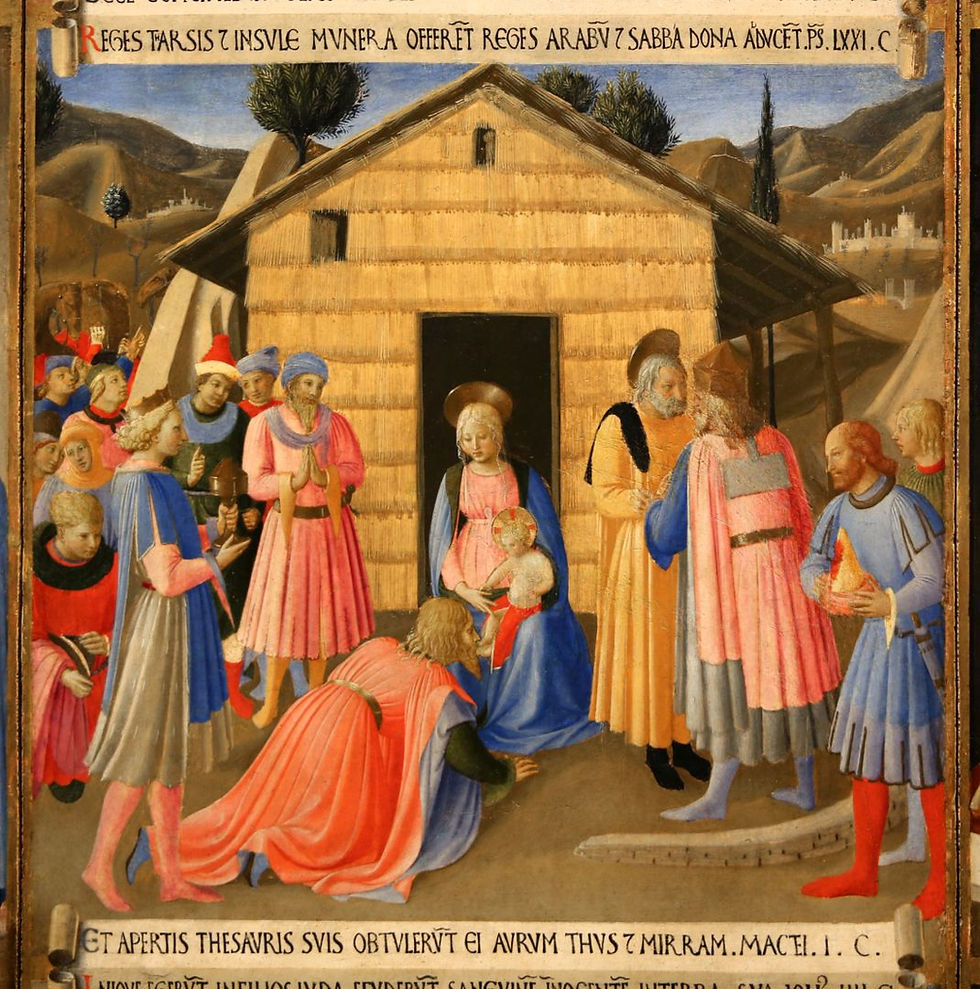
In the ancient world, celestial beings, such as stars and planets, were considered to be divine, and their movements, properly interpreted, able to foretell the future. What is interesting in this passage is that the magi call the star that led them to Jesus, ‘his star’, thereby describing the star as belonging to him. In other words, the stars are not Christ’s master or god, rather, he is their master and God. In the beginning of John’s Gospel, we hear that in the beginning was the Word (Jesus), and the Word was with God, and the Word was God, and that all things that exist were made through him. Jesus is, therefore, the creator of the stars—he is the divine one, not them.
We see here a great reversal. The pagans who worship the stars, have seen in the stars themselves a sign which points to their creator. It is as though the stars themselves are bowing down before the true God. The magi’s own pagan religion, which worshiped the creature rather than the creator, through the providence of God, has taken them beyond their limited understanding; it has brought them to bow down before the very author of creation, to worship the one true God, who has taken human form. All creation, properly understood, points to God as its creator, as St Paul says in the first chapter of his Letter to the Romans.
This understanding is reflected in the gifts the magi offer the infant Christ. They bring gold because that is the gift for a king, the King of the Jews. They bring myrrh because this looks forward to his death on the cross: on the cross, Jesus is offered a drink mixed with myrrh, and is anointed with myrrh at his burial by Joseph of Arimathea. While these two gifts point to Christ’s ministry as God and man, frankincense, in contrast, is a gift one offers to the gods, or, in this case, to the one, true God. An epiphany takes place here, when the stars bow down before their Lord, as do the magi, who brings gifts proper for a divinity.
In these three scenes, these three epiphanies, Jesus manifests to us what God is like.
In his nativity, he leaves his throne from on high, and comes to us as a child in a manger, manifesting God’s supreme humility. St Paul tells us that, “though he was in the form of God, he did not count equality with God a thing to be grasped, but emptied himself, taking the form of a servant, being born in the likeness of men.”
In his baptism, he teaches, by his own example, the way of salvation, which comes through being baptised with water in the name of God’s true Trinitarian nature, in the name of the Father, and of the Son, and of the Holy Spirit.
Finally, in his miracle at the Wedding of Cana, Jesus foreshadows the great gift he will give to the Church in the Eucharist, which is the gift of himself. He says to his disciples in the Gospel of John, “Yet a little while, and the world will see me no more, but you will see me; because I live, you will live also.” We too see him, with the eyes of faith, in the Eucharist—we live through him, who is life itself.
Today, brothers and sisters, let us bow down before our Lord in the Eucharist, as the magi and even the stars bowed down before him in the manger. And let us ask our king and our God, who gave himself unconditionally to us, to give us the grace to imitate and return that gesture, and to give ourselves unconditionally to him.

Fr Matthew Boland, OP is the Master of Students, assigned to St Dominic's Priory, Melbourne.


Comments