


Third Sunday in Lent, Year A (2026) - Fr James Baxter, OP

I would love to know where this woman at the well ended up. As we become familiar with the Gospel stories it is natural that we should be interested in what the characters did and how they lived for the rest of their lives. This is especially so for the Samaritan woman, because this is the longest conversation that Jesus has with any one person in the Gospels.
That is not to say, though, that it was a long conversation. Perhaps they only spoke for a few minutes. But in that encounter, as long or short as it was, Jesus takes the woman from what she is immediately concerned with—the needs and conventions of the day, “I need water …”, “Jews don’t talk to Samaritans …”–to talking about prayer, and worship, and who the Messiah is. And Jesus draws out her faith in such a way that at the end of the reading she is bringing other people to him.
What changes? What draws her from these earthly concerns of hydration and social convention to the highest things we can give our attention to: prayer, worship, and salvation?
The change happens first when Jesus touches on a source of pain. He drops into the conversation the fact that he knows about the five husbands she has had in the past, and that she’s currently with a man who is not her husband.
It’s not a rebuke. It’s to show her that he knows her, and that everything that he says about life with God is for her. It’s not just for holy people. It’s not for who he thinks she might be. What he offers her is for her as the person she is, with all the choices, right and wrong, that have gone into making her who she is.
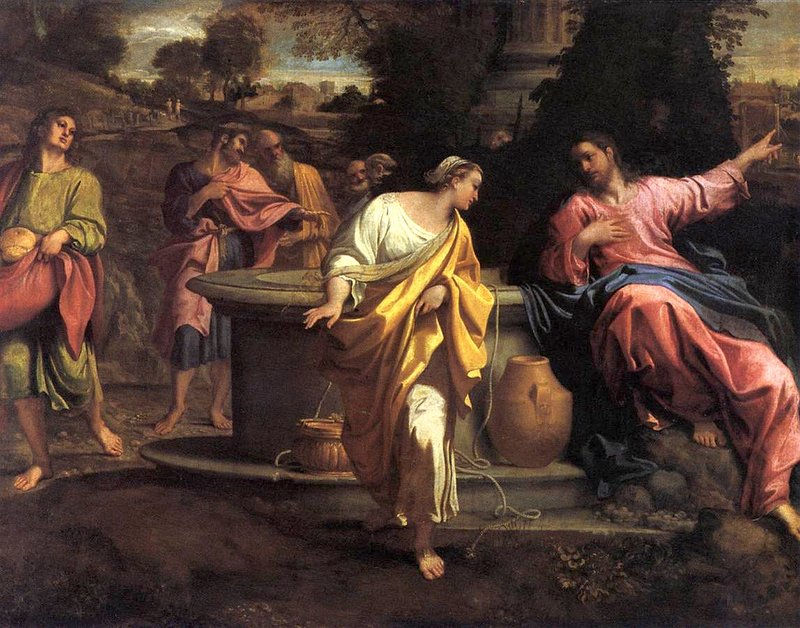
What does Jesus offer? He calls it the “living water” that will “well up to eternal life.” A few chapters later in John’s Gospel the evangelist clarifies that the living water is the Spirit, which those would believe in Jesus would receive (Jn 7:37-39). We could also say, to paraphrase St Paul in the second reading today, that the living water is the love of God which is poured into our hearts by the Holy Spirit. What these explanations amount to is that God shares his life and love with us.
This is the highest and greatest object of desire. But just as the woman initially seems to think Jesus is talking about a bucket that never empties (and is contemplating how desirable that is), we can also be way off the mark. From a young age we are crying out for and chasing after things that we desire. A few years later, we are making goals and working away at them. But how high do our desires go? Do we ever desire anything beyond what is obvious and earthly and immediate?
It’s a bit strange that we have to be convinced that there is more to desire. One of the characteristics of human life is that we always want more. One of the biggest hints we get that we are made for something more is that nothing in this life can satisfy us. Again, perhaps we remember how it was as children. You wanted a toy, you got the toy … a week later you were sick of it. Later in life, we have other goals: for prizes, achievements, relationships, jobs, houses.
Are we satisfied? We always want something more because we are made for the infinite. We are made for this living water that is the life and love of God. If we make our life’s aim anything less than that, even if we achieve it, we will still be asking – is there anything more?
It is true that we don’t know what happened to this woman, after she races off from the well in wonder to share her testimony. Given that this this was a private conversation, it was either handed on to the church from Jesus or from her. I would like to think it was a story that the woman told and retold to the members of the early church who were eager for first-hand testimonies of Jesus and his ministry.
Whoever it came from, we are the beneficiaries. It has everything: curiosity, conversion, faith, witness. Importantly, though, it’s a story that prompts us to ask some of the most helpful questions we can ask ourselves, and to get the answers clear in our minds: What is it that I desire the most? And is there anything more to desire beyond that?

Fr James Baxter, OP is the Parish Priest of Broadway, Glebe, and Pyrmont, New South Wales.


Comments